
The Call-Center Era Is Over: Why Modern Support Requires High-Skill Nearshore Teams
January 1, 2026

AI Took the Front Line And Raised the Bar for Humans
When chatbots reset passwords, answer billing questions, and deflect basic tickets in seconds, every human interaction becomes a high‑stakes moment. Customers only reach a person when they’re stuck, frustrated, or facing something complex.
In that world, a low‑skill, script‑reading call‑center agent is not just “good enough.” It’s a liability.
The standard has shifted: you don’t need a cheap call center. You need high‑skill, bilingual specialists who can handle complexity, connect with empathy, and protect your brand – without blowing your runway.
That’s where high‑skill nearshore teams come in.

Where Puzzle Fits In
Puzzle originally focused on high‑skill LATAM talent for engineering and product roles. As our SaaS clients scaled, the next system to break wasn’t code – it was support.
They had:
Growing customer bases
AI deflecting the basics
Founders and product teams getting pulled into escalations

So we applied the same strategy‑first approach we use for engineering teams to support:
Design the support org: tiers, SLAs, coverage windows, competencies, handoff points.
Staff it with vetted LATAM talent: bilingual, technical aptitude, cultural alignment.
De‑risk the model: ~30% lower payroll vs equivalent U.S. roles, 90‑day pilot, and you only pay for people you keep.
This isn’t a pivot away from tech. It’s the same engine, aimed at a different bottleneck.
The End of the Call-Center Playbook
The traditional call‑center BPO was built for a pre‑AI world: hundreds of agents on a production floor, tied to desktops, reading from scripts. It was optimized for call volume, not customer outcomes.
For modern SaaS, that model creates systemic problems:
1. High attrition
Call centers often run 30–45% annual turnover.
Constant rehiring and retraining
Lost institutional knowledge
Inconsistent quality
Hidden cost: tens of thousands per year just to stay in place.
2. Low‑skill, script‑driven talent
Agents trained to follow a script struggle with:
Edge cases
Technical issues
Nuanced, emotional conversations
Result: more escalations to engineering, slower resolutions, and frustrated customers.
3. Poor customer satisfaction
Limited empathy and lack of technical depth show up directly in NPS and CSAT. When support feels like a wall, not a partner, customers start looking elsewhere.
4. Rigid physical setups
Agents tied to a single call floor and outdated desktops can’t adapt when:
There’s a local outage
Remote / hybrid work is needed
You require flexible coverage
Downtime quickly becomes lost revenue and erodes trust.
5. Slow resolution times
Multiple handoffs between tiers, poor context, and lack of autonomy lead to:
Long time‑to‑resolution
Customers repeating themselves
Internal frustration between support and product
6. Poor cultural and time‑zone alignment
Offshore centers running opposite schedules and with limited shared context struggle to:
Collaborate with U.S.‑based teams
Move quickly on priorities
Maintain alignment with product and roadmap
The result: duplicated work, delays, and friction that compound as you scale.
The New Era of Support : Smaller, Sharper, Nearshore
Modern support doesn’t look like a sea of headsets. It looks like smaller, sharper teams of highly skilled, culturally aligned specialists equipped to act as an extension of your company.
And it starts with design, not headcount.
Support org blueprint: What tiers you need, what SLAs matter, what coverage windows are required, and how tickets flow between support, product, and engineering.
Competency mapping: What skills each role actually needs (technical, communication, language, tools).
Nearshore staffing: Hiring bilingual, high‑skill specialists in aligned time zones who operate like internal team members, not a separate vendor.
This new model directly addresses the old pain points:
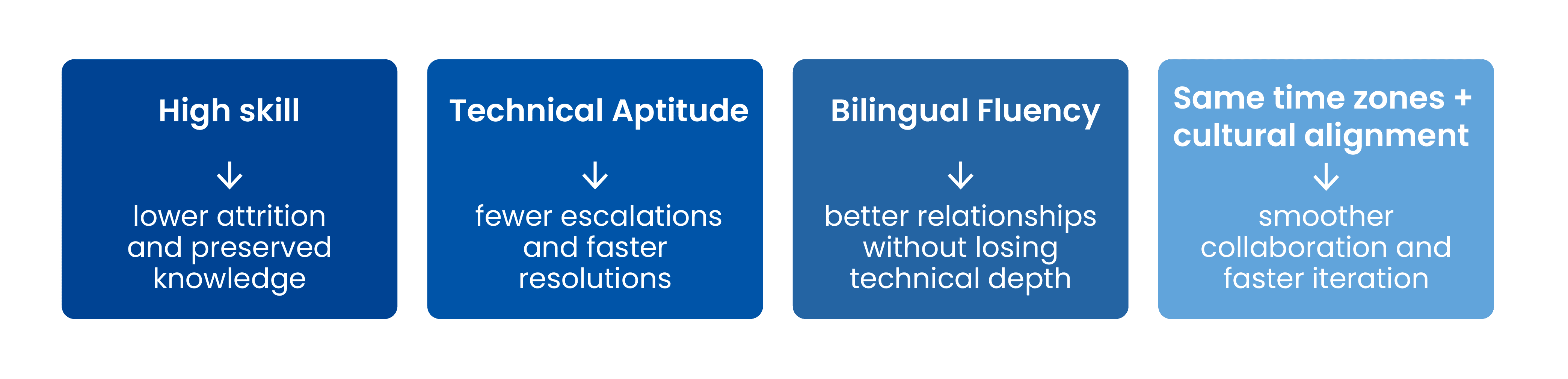
Reliability by Design: Beyond “Backup Wi‑Fi”
Reliability is not just a UPS under the desk. It’s an operating model.
Puzzle designs support around hybrid, resilient work:
Hybrid setup: Agents can work from home or coworking spaces without missing a beat.
High‑performance gear: Every Puzzle agent uses a modern laptop (e.g., Core i7, 16–18GB RAM, 1TB SSD) so they can:
Reproduce complex bugs
Run multiple user profiles
Handle heavy apps without lag
Resilient infrastructure:
Long battery life and UPS systems
Redundant internet (primary + backup)
Coworking spaces as secondary locations
Because reliability is baked into the model, not bolted on later, you can commit to aggressive growth targets without betting your NRR on a fragile support operation.
Why This Is a Natural Fit for Puzzle
Puzzle has always specialized in highly skilled technical talent from Latin America: software engineers, designers, product managers.
For many of our SaaS clients, the next critical need after building the product was building the right support and CX teams.
The same standards we use for engineering hires apply to support:
Technical ability (so they can actually solve problems)
Clear communication
Cultural alignment and ownership
Bilingual fluency
We didn’t reinvent ourselves. We extended the same model:
Strategy‑first: We design the support org and roles.
Nearshore engine: We staff it with vetted LATAM talent.
De‑risked offer: ~30% lower payroll vs equivalent U.S. hires, 90‑day pilot, pay only for people you keep.
ProLine’s Growth With Puzzle
ProLine, a SaaS CRM for roofing contractors, scaled from 60 to 326 clients in just over a year and an average of 1,300 daily active users.
They needed to grow support without:
Crushing U.S. payroll
Burning out founders and product
Letting NPS collapse under growth
Puzzle grew their support team from 1 to 35+ bilingual, technically capable specialists to keep pace without compromising quality.
The result: ProLine scaled rapidly without turning their success into a support disaster.

How to Choose the Right Nearshore Partner
If you’re considering a nearshore support partner, ask these questions:
Vetting:
Do they screen for technical skill, problem‑solving, and communication – or just language and basic call handling?Integration:
Will nearshore hires feel like internal employees (same tools, stand‑ups, Slack, and culture), or like a separate vendor team?Org design:
Do they help you design the support org (tiers, SLAs, workflows), or just fill seats you define under pressure?Mobility and resilience:
Are agents equipped with modern laptops and hybrid work capability, with clear plans for outages and disruptions?Scalability:
Can they reliably go from 1 → 10 → 35 people over 6–12 months without quality dropping?Risk and economics:
Do they share the risk with you (pilots, performance‑tied terms), or do you absorb all of it through long contracts and upfront fees?
Puzzle’s answer to each of these is “yes” – by design.
The Path Forward: AI + Humans Together
AI isn’t replacing human support. It’s redefining it.
Let AI handle the repetitive, low‑judgment work.
Let high‑skill, bilingual humans handle complex, high‑empathy, higher‑stakes interactions.
Design your support org so both work together, not in conflict.
That’s how you:
Protect brand equity
Reduce churn
Turn support into a growth engine instead of a cost center
The more uncomfortable truth:
Without highly skilled, nearshore CS/CX teams, capital‑efficient, fast‑scaling SaaS companies can’t win. You can’t scale with a leaky bucket. Every customer lost through poor support erases the gains you fought to win.
FAQ
Isn’t outsourcing risky for customer experience?
It is, if you treat it like a separate, low‑skill vendor. It’s not, if nearshore hires are embedded into your tools, rituals, and culture. Puzzle’s model is to build teams that feel like an extension of your company, not a third‑party add‑on.
What makes Puzzle’s model more reliable?
Agents operate in a hybrid environment with modern laptops and redundant connectivity. They’re not tied to a single floor or a single connection. Power or connectivity issues don’t take your support org down.
Why invest in top‑tier equipment for support?
Because performance matters. High‑spec laptops allow agents to replicate complex issues, juggle multiple tools, and solve problems faster. That translates directly into better resolutions and higher CSAT.
How fast can I scale with a nearshore partner?
With the right process, you can go from a single hire to a fully functioning specialist team in months. ProLine went from 1 → 25+ high‑skill nearshore support reps in roughly a year.
How does cultural alignment improve results?
When your team works in similar time zones and understands your work culture, you get faster decisions, fewer misunderstandings, and better outcomes for customers. It also makes collaboration with product and engineering significantly smoother.
Ready to leave the call-center era behind?
If you’re scaling and still relying on a low‑skill call‑center model, you’re carrying unnecessary risk.
Puzzle designs and builds high‑skill, bilingual nearshore support teams with vetted LATAM talent, at 30% lower payroll than equivalent U.S. hires – under a 90‑day pilot where you only pay for people you keep.
If you’re ready to modernize support and stop gambling with customer experience, contact Puzzle to design your next‑generation support org.









Still thinking it over?
Mind sharing what’s holding you back?
Let’s Talk About What You’re Building.
Whether you’re scaling fast or still exploring, we’re here to help you get it right.

Follow us.


